Five Industries Standing at the Quantum Threshold — And What US Decision-Makers Should Do Before the Disruption Arrives
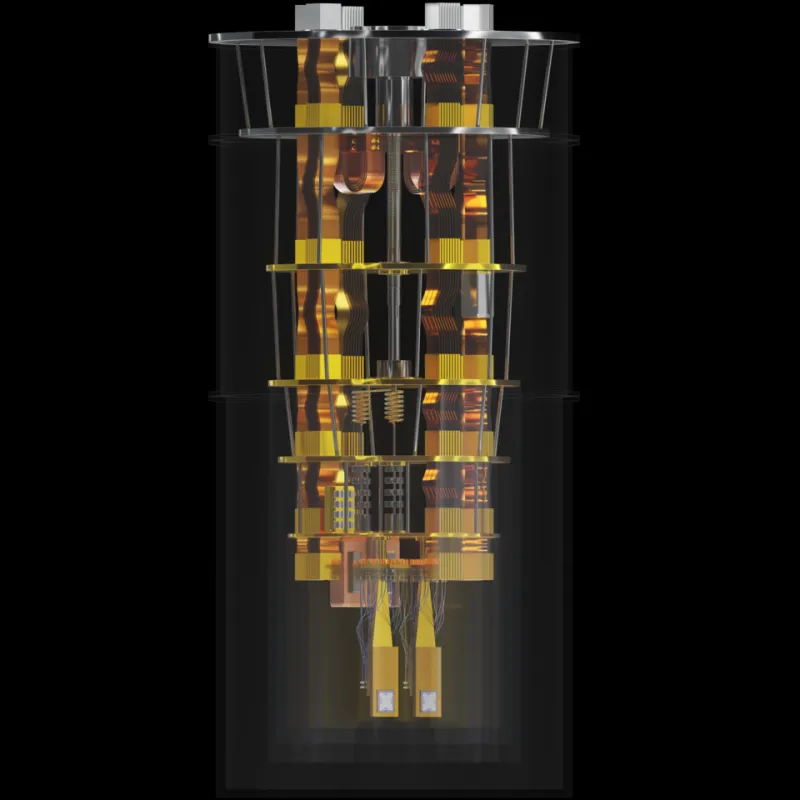
Photo: OJB Quantum, CC BY 4.0, via Wikimedia Commons
For years, quantum computing occupied a comfortable position in the landscape of emerging technology: perpetually promising, perpetually distant. That comfortable distance is collapsing. In 2024, IBM reported operating a 1,121-qubit processor, Google announced significant progress toward fault-tolerant quantum systems, and a growing ecosystem of startups — many funded by US venture capital — began delivering quantum-as-a-service capabilities to enterprise clients.
The transition from laboratory curiosity to commercial infrastructure is no longer a question of whether but when — and for the five industries examined below, that timeline is measured in years, not decades. At Ocean Wave Tech, our editorial mandate is to help US business leaders anticipate rather than react to technological change. What follows is an honest assessment of where quantum disruption is most imminent, how far along each sector currently sits, and where early-mover investment opportunities are beginning to crystallize.
1. Pharmaceuticals: Rewriting the Rules of Drug Discovery
Current State: Drug development is extraordinarily expensive — the average cost of bringing a new compound to market exceeds $2.6 billion, and failure rates remain stubbornly high. A significant portion of that cost stems from the computational limitations of classical computers, which struggle to accurately simulate molecular interactions at the quantum level.
The Quantum Advantage: Quantum computers are uniquely suited to modeling molecular and chemical systems because they operate on the same quantum mechanical principles that govern molecular behavior. Companies including Zapata Computing and Quantinuum are already collaborating with major pharmaceutical firms to develop quantum algorithms capable of simulating protein folding and molecular binding with unprecedented precision.
Realistic Timeline: Meaningful quantum advantage in early-stage drug discovery is plausible within three to five years, with full pipeline integration likely extending to the 2030s.
For US Investors: Watch for partnerships between established pharma companies and quantum hardware providers. Early-stage investment in quantum chemistry software platforms represents a particularly compelling opportunity given the sector's demonstrated willingness to pay for computational breakthroughs.
2. Financial Services: Beyond the Limits of Classical Optimization
Current State: Wall Street has long been a voracious consumer of computational power. Portfolio optimization, risk modeling, fraud detection, and derivatives pricing all involve combinatorial complexity that strains classical systems — particularly as market data volumes and regulatory requirements continue to expand.
The Quantum Advantage: Quantum algorithms — particularly the Quantum Approximate Optimization Algorithm (QAOA) — offer theoretical speedups for portfolio optimization problems that would be computationally intractable for classical machines. JPMorgan Chase and Goldman Sachs have both established dedicated quantum research divisions, signaling that this is no longer speculative investment.
Realistic Timeline: Quantum-enhanced Monte Carlo simulations for risk analysis are likely to reach practical deployment within two to four years. Broader adoption in trading and portfolio management will follow as error correction matures.
For US Investors: Fintech platforms building quantum-ready infrastructure today — particularly in risk analytics and compliance modeling — are positioning themselves for significant competitive advantage as quantum capabilities scale.
3. Cybersecurity: A Double-Edged Disruption
Current State: This is the sector where quantum computing presents the most urgent and potentially destabilizing implications. RSA encryption — the foundation of most current internet security infrastructure — is theoretically vulnerable to a sufficiently powerful quantum computer running Shor's algorithm. The National Institute of Standards and Technology (NIST) has already finalized its first set of post-quantum cryptographic standards in response.
The Quantum Advantage (and Threat): The disruption here is bidirectional. Quantum computing threatens to render existing encryption obsolete while simultaneously enabling quantum key distribution (QKD) systems that offer theoretically unbreakable communication channels. The organizations that migrate to post-quantum cryptographic standards earliest will be best positioned regardless of how quickly adversarial quantum capabilities develop.
Realistic Timeline: Security experts recommend treating post-quantum migration as an immediate priority. Nation-state adversaries may already be executing "harvest now, decrypt later" strategies, storing encrypted data today with the intent of decrypting it once quantum capabilities mature.
For US Investors: Post-quantum cryptography vendors, quantum-secure VPN providers, and cybersecurity consultancies specializing in cryptographic migration services represent high-conviction opportunities with near-term demand drivers.
4. Materials Science: Engineering the Impossible
Current State: The discovery of new materials — superconductors, catalysts, battery chemistries — is constrained by the same molecular simulation limitations that impede pharmaceutical research. Classical computers can approximate material properties but cannot model the full quantum mechanical complexity of novel compounds.
The Quantum Advantage: Accurate quantum simulation of material properties could accelerate the development of room-temperature superconductors, more efficient solar cells, and next-generation battery technologies that are critical to the US clean energy transition. The Department of Energy has identified quantum computing as a strategic priority for materials research, directing significant federal funding toward this intersection.
Realistic Timeline: Quantum-assisted materials discovery is likely to yield commercially significant results within four to six years, with the most immediate applications in battery technology and industrial catalyst design.
For US Investors: The convergence of quantum computing and clean energy materials represents one of the most compelling long-term investment themes of the decade. Companies bridging quantum simulation expertise and advanced manufacturing are worth monitoring closely.
5. Logistics: Solving the Unsolvable Optimization Problem
Current State: Modern logistics networks — whether managing last-mile delivery for an e-commerce platform or coordinating global shipping for a multinational manufacturer — involve optimization challenges of staggering complexity. Classical algorithms find workable solutions but rarely optimal ones, and the cost of suboptimal routing at scale is substantial.
The Quantum Advantage: Quantum computing excels at navigating vast solution spaces to identify genuinely optimal outcomes — precisely the capability that logistics optimization demands. Companies including D-Wave have already demonstrated quantum-assisted routing improvements with select logistics partners, and the results, while early-stage, are encouraging.
Realistic Timeline: Hybrid classical-quantum optimization systems are likely to deliver measurable logistics improvements within two to three years, with fully quantum-native systems following as hardware matures.
For US Investors: Logistics technology platforms that are building quantum-compatible optimization layers into their existing software architecture today will be positioned to deliver step-change performance improvements when the hardware catches up.
The Strategic Imperative
Quantum computing does not require any single industry to abandon its existing technology investments immediately. What it does require is that US executives and entrepreneurs begin building quantum literacy within their organizations, monitoring vendor developments in their sectors, and identifying the specific computational bottlenecks in their operations that quantum capabilities are most likely to address.
The next wave of technological disruption rarely announces itself with adequate warning. The organizations that are studying quantum computing seriously today — even before full commercial viability arrives — will be the ones positioned to capitalize decisively when it does.